

From dry soil to Oasis: Quinta da Fornalha's Edible Miniforest and the Miniforest Revolution

Updated: Aug 20, 2025
Quinta da Fornalha , a reference in agroecological practices in southern Portugal, celebrates two years since the Agroecology and Arts Festival that marked the start of the transformation of a 700 m² space into a food forest .
Located in Castro Marim and renowned for its organic production of figs, carob, and citrus fruits, the farm runs an agroecological project that stands as an example of regeneration and innovation in the Algarve.
In total, more than 1,000 plants of 80 species were introduced into systems inspired by agroecology , agroforestry , permaculture food forests , syntropic agriculture , and mini forests created according to the Miyawaki method , with visible and inspiring results. Without the use of chemicals and with a model based on biodiversity , density , and soil regeneration , the Quinta da Fornalha food forest has become an example of how to regenerate landscapes while producing food sustainably.


An agroecological system created by many hands
The project was supported by several organizations and entities, including Associação Catavento , Savana , Cineclube de Tavira , EEA Grants , Direção‑Geral do Património Cultural , Direção‑Geral das Artes, Ventis Analytika, Câmara Municipal de Castro Marim, Cooperativa Sulitanea and Biggest Mini Forest — strengthening the link between culture, community and sustainable land management.
After the initial creation of 400 m² of the edible forest in compact clay soil, 50 m² of parallel cultivation was carried out on poor, rocky terrain within the farm, to test the method's adaptability to challenging conditions — with surprising results and valuable lessons learned.
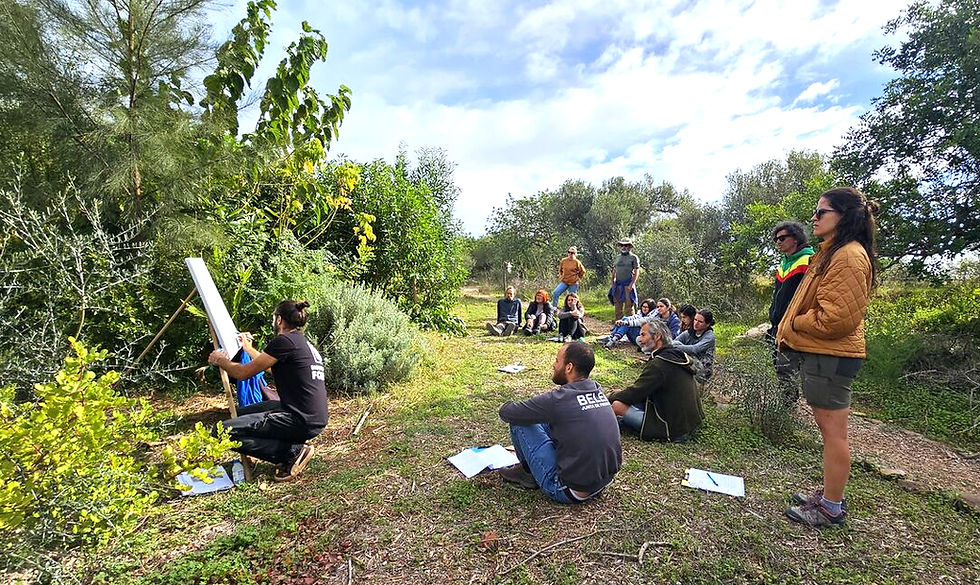
Over the past two years, Quinta da Fornalha has hosted four edible miniforest workshops promoted by Biggest Mini Forest , responsible for expanding the edible forest by a further 80 m² , and the first Edible Miniforest Course (“Mini Food Forest Training”), which contributes to adding approximately 100 m² of area planted with miniforests following Biggest Mini Forest’s own model.
In November 2024 , the farm hosted Juan Antonio Hernández ( AgrosimbiosisLab , Tenerife), a specialist in edible forests for arid climates, who led practical workshops and a conference at the Tavira Municipal Library.
In total, these activities — driven by the 2023 festival — involved more than 200 participants and have since contributed to the regeneration of 700 m² of area.


The future of these edible forests
Following the success of the experimental phase, Quinta da Fornalha is preparing to expand its 9-hectare edible and productive forests by 2025. To support this vision, the Sulitanea cooperative was created, focused on promoting sustainable agroecological development. This initiative builds on the farm's legacy of innovation, community commitment, and environmental stewardship.
The ambition is for Quinta da Fornalha to become not only a replicable example, but also a living learning center, welcoming people from all over the world for training, exchanges and research projects on edible mini-forests and agriculture.

Featured Events – September/October 2025
Training provided by Juan Antonio Hernández , with the possibility of two in-person phases:
📍 September 11-14 / September 18-21
🔗 More information: cooperativasulitanea@gmail.com / Whatsapp +34 673 161 956 / +351 931 145 105
Mini Food Forests Training – Theoretical and practical training promoted by Biggest Mini Forest, open to anyone interested in learning how to create edible forests in any context — from an urban garden to a rural plot.
📍 Online Sessions: September 29th – October 2nd (1h30 each)
📍 In-Person Phase: October 10th – 12th, at Quinta da Fornalha
📘 Includes a complete guide to creating an edible mini-forest system in 5 steps
Important: If you wish, you can attend to online sessions only
🔗 Registration open: www.biggestminiforest.com/mini-food-forest-training
About the organizers
Quinta da Fornalha Farm
Managed by Rosa Dias, Quinta da Fornalha has been combining organic farming with environmental education, eco-tourism , and artisanal food processing for over 20 years . Its mission is to restore soil, revive local knowledge, and inspire communities .
Juan Antonio Hernandez
An international facilitator with over 30 years of experience in edible and productive forests, working on projects in the Americas, Africa, Portugal, and Spain, Juan Antonio Hernández was a key driving force behind the edible mini forest movement underway at Quinta da Fornalha.
Biggest Mini Forest
Founded by Luís Afonso and Ana Laura Cruz , Biggest Mini Forest is an international network dedicated to agroecological regeneration. It teaches a 3x3-meter miniforest model that is accessible , scalable, and adaptable to different contexts. Since 2023, it has supported the creation of more than 70 miniforests in Portugal and abroad, promoting biodiversity, food security , and connection with nature .
Related Topics: Miniforests, Edible Forest, Agroforestry, Miyawaki Method, Syntropic Agriculture, Agroecology, Food Forests, Soil Regeneration, Water Management, Biodiversity.
Internal References (Biggest Mini Forest)
Further reading (methods, science, and practice)
Agroecology & agroforestry
Miyawaki method / miniforests
Syntropic systems & food forests


Comments